top of page


War of the Seven Seals
Our Captivation Journey
Welcome to our Series in this fantastic World
Eden is a mosaic of realms where light and ruin share the same sky—ivory citadels, river-thrones, ice capitals, volcanic forges, and storm-crowned mountains. Each place is a doorway into a different law of nature, and every horizon carries the weight of ancient powers and unfinished wars
.jpg)
Eden Realms

Trillmaten - Capital of Civilized Realms

Tirandel - Pristama Realm

Falembe - SimasSellum Realm

Malldown Fortress

Selican - Ma Fretal Realm

Nilum - Zautizma Realm
Pristama Lands

Oracle of Sendan

Tangerine Village

Terraroxa - Intamale
Trillmaten is the majestic capital of Eden’s Civilized Realms, built where the twin rivers Perath and Ghion meet yet run side by side in stark contrast—green and limpid against dark, swirling currents—before plunging into colossal cataracts that veil the city in mist; at its center rises the kilometer-high Tree of Life like a sacred axis, while nearby the imperial palace gleams with crystal domes above the abyss of Farfarah, the immense waterfall whose newborn waters gather into the Great River, giving the whole city the feel of a monumental, river-carved throne between divinity and engineering.
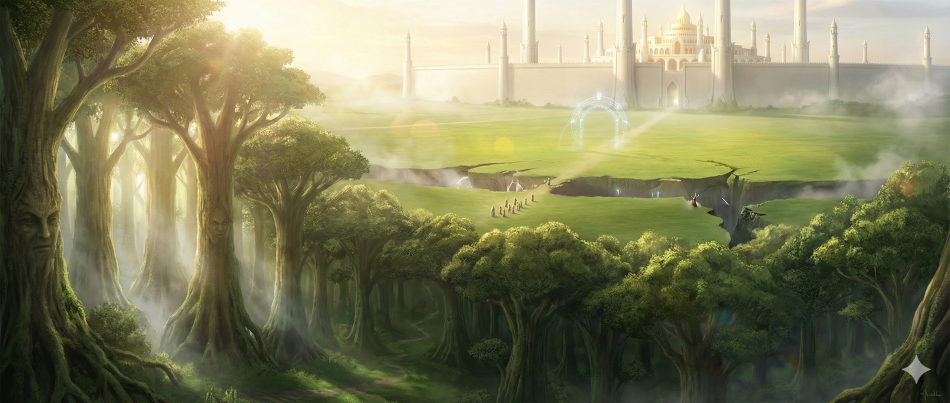
Tirandel is the radiant heart of Pristama in Eden: a city approached through a living, warding forest that can swallow armies, then across a vast greensward toward an ivory-walled citadel crowned by thirty-three towers—three of them colossal—where Pristacaedum, the “Light of the People,” rises like a fortress sculpted by song, its harmonious spires and inner houses of knights and justice embodying a realm built as much from sacred order as from stone.
Falembe is the infernal capital of SimasSellum in Eden’s southeast, a volcanic island-city forged from black basalt and obsidian under sulfur mists and corrosive rain, where lava-rivers run like streets and the skyline is dominated by a soot-breathing volcano that doubles as a fortress—an iron-and-stone citadel bristling with jagged spires, ash plumes, and furnace-glow windows—projecting a mood of brutal, industrial majesty in total defiance of Eden’s white, music-wrought realms.
Malldown is the lone hard refuge in Shoria Carmnal—the Fugitives’ Marsh—a grim fortress rising from one rare rock island amid endless poisonous bogs, bottomless black water, and drowned reed-forests under perpetual gray rain; the surrounding pantanos are a predatory maze of sucking mud, hidden sinkholes, venomous creatures, and shadowed pools where savage fish churn beneath the surface, while Malldown’s stained walls and torchlit battlements stand like the only fixed line between the hunted and a swamp that wants everything to vanish.
Selican is the icebound capital of the Ma Fretal, built on a massive ancient ice shelf at the feet of Sel, the godvolcano—an impossible city of translucent ice architecture and snow-packed districts, where a noble quarter climbs the frozen lower slopes of the mountain and a coastal quarter clings to the narrow boundary between rock and sea, facing the dark turquoise-black waters of Liktal (Seaare), the ocean that refuses to freeze even in killing cold.
Nilum is Eden’s free confluence-port, a luminous coastal city where the Great Nilum River—born from the meltwater of Budafer’s towering peaks—meets the Turquoise Sea with such force that its freshwater can push the ocean back for leagues; domes and white-marble minarets crown a skyline of canals, bridges, bazaars, and harbors, and the whole place feels like a neutral crossroads carved from light, water, and wandering.
Pristama Land is Eden’s realm of luminous order and living wardcraft, where beauty is inseparable from defense: a country of sacred forests that can swallow invaders, wide ceremonial greenswards, and ivory cities shaped as if music itself became stone. Its heart is Tirandel and the fortress-palace Pristacaedum (“Light of the People”), guarded by layered “gates” of illusion, chasms, and towering walls—an entire landscape designed to test intent as much as strength
Oracle of Sendan — A mist-walled mountaintop sanctuary built out of layered symbols: seven colossal white horses bite chains that lead to a roaring circular fountain of seven blue water-dragons, then to a Parthenon-like temple whose seven columns anchor the warding geometry. Above it all, seven ebony eagles hang impossibly in midair, and inside the holy core waits a candlelit red throne where twin seers deliver prophecy with one voice.
Tangerine Village — Perched on Budafer’s high plateau in thin, bright air, it looks like a harmless alpine hamlet—bridge, station, square, playful details—until it “locks” into ritual. Villagers gather with clockwork timing around the bandstand, trees heavy with strange fruit watch overhead, and Lucy’s dance and cutting song bend attention like a spell, turning the whole town into a quietly controlled stage.
Terraroxa — The goblins’ coastal capital is a cheerful, engineered sprawl: bright round clay houses and gardens at the edges, then dense markets, workshops, and factory quarters pulsing with invention. The sky is busy with balloons and dirigibles, arrivals flow through tidy automated systems, and the city’s culture feels like one ongoing experiment—part port-town, part machine-hive, part festival of cleverness.

Budafer - Fahremum Realm

Gladen Fach - Angel's School

Setsoto - Pallacadium Realm
Budafer is the highest and most formidable mountain realm in Eden, a colossal ring of peaks whose glaciers give birth to the Great Nilum River and whose heights loom like an eternal crown over the eastern wastes; at its heart rises the White Throne, a solitary summit buried under immaculate snow and storm-shrouded power, homeland of the Brothers of Budafer and a sacred source-land where nature’s spirit feels older, harsher, and nearer to divinity than anywhere else.
Gladen Fach (GF) — Eden’s academy-fortress where beauty and authority share the same marble: you enter through towering black iron bars tipped in gold, the “GF” monogram stamped into the gate like a verdict. Inside, everything is symmetrical and immaculate—courtyards laid like diagrams, training yards that feel military, long colonnades and disciplined dorm blocks—an elegant citadel designed to turn students into polished weapons.
Setsoto — A great southern river-city seen at its worst: dusk, smoke, firelight, and a population trapped on the north bank because the only bridge south has been destroyed. Warm ochre buildings and old ramparts burn in patches while siege lines press in, refugees crowd the riverfront steps, and the shattered bridge stubs become the city’s fatal silhouette—until a desperate countercharge turns that ruined crossing into the battle’s hinge point.
bottom of page